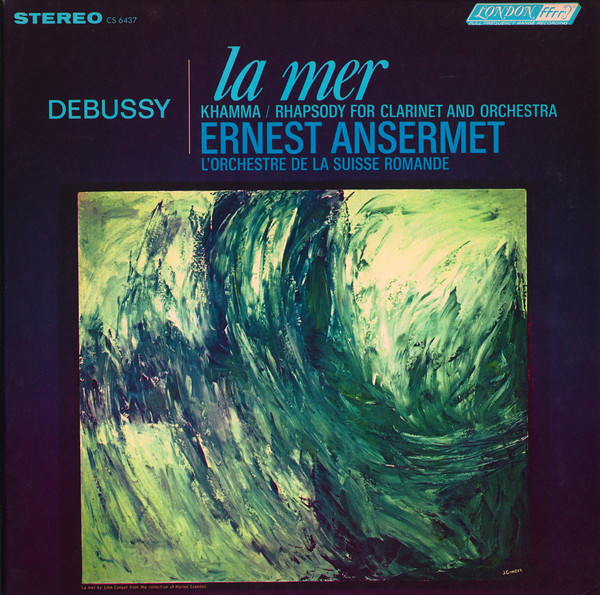
This set of Debussy was recorded in 1957-58 at the Victoria Hall, Geneva in Switzerland. This was a favourite venue for the Decca recording engineers as it had wonderful acoustics and even today, over 65 years later, this recording easily stands the test of time and is superior as an audio product. The Suisse Romande Orchestra did not always have a reputation for infallible technical security but on this occasion they prove to be more than capable of inspirational playing of complete security.
Ernest Ansermet, their founding and chief conductor for 50 years, was noted for his devotion to the printed notes in the musical scores that he conducted. He was opposed to anything that was added by interpreters in the form of false emotional overlays preferring to concentrate on structural clarity and directness of expression.
That approach perfectly suits all of these works resulting in music-making strong in sparkle and verve on the one hand and illuminating on the other by making clear so many details that are so frequently lost in the lushness of other performances.
A strong sense of internal and forward motion is apparent in all three works. This is achieved by observation of countless internal details as referred to above. As with any other lifetime collector of recordings one gets to become familiar with a considerable number of fine alternatives and knows what to expect and what to appreciate. It therefore comes as quite a shock to find a recording, and especially one of this vintage, that has escaped previous notice and one that still has so much more to add to one’s awareness. That is the measure of Ansermet’s achievement in La Mer.Direct comparisons are not so easy to make in Jeux and, even more, in Khamma due to their relative rarity. These are both late ballet scores. Khamma (2010) was conceived as a work for piano. For reasons that are unknown Debussy handed the task of orchestrating it to his assistant, Charles Koechin. This task was accompanied by 100 pages of detailed instruction and personal supervision though and listeners would find it hard to tell that the result was not entirely the work of Debussy. Jeux (2013) was entirely completed by the composer.
Direct comparisons are not so easy to make in Jeux and, even more, in Khamma due to their relative rarity. These are both late ballet scores. Khamma (2010) was conceived as a work for piano. For reasons that are unknown Debussy handed the task of orchestrating it to his assistant, Charles Koechin. This task was accompanied by 100 pages of detailed instruction and personal supervision though and listeners would find it hard to tell that the result was not entirely the work of Debussy. Jeux (2013) was entirely completed by the composer.
In both of these works these two recordings have a great sense of organic, and therefore balletic, movement, more so than other recordings such as those of Jeux by Haitink or Rattle for example. This is brought about by clearer textures that enable the rhythmic elements to make their effect more clearly. Bearing in mind the dance intentions of the two pieces, one must conclude that Ansermet is far closer to the composer’s intent.
The remastered recordings in this ‘Legends’ at 96kHz 24-bit are remarkable and are more than a match for later recordings. They have a totally natural sense of acoustic and sonic depth and width. Textures are authentic. The orchestra is on top form and no-one need hesitate on technical grounds. On musical grounds this is a disc that collectors ought to snap up while copies remain.
In summary this disc is an essential purchase for collectors without any need for compromise. (I. Giles)


